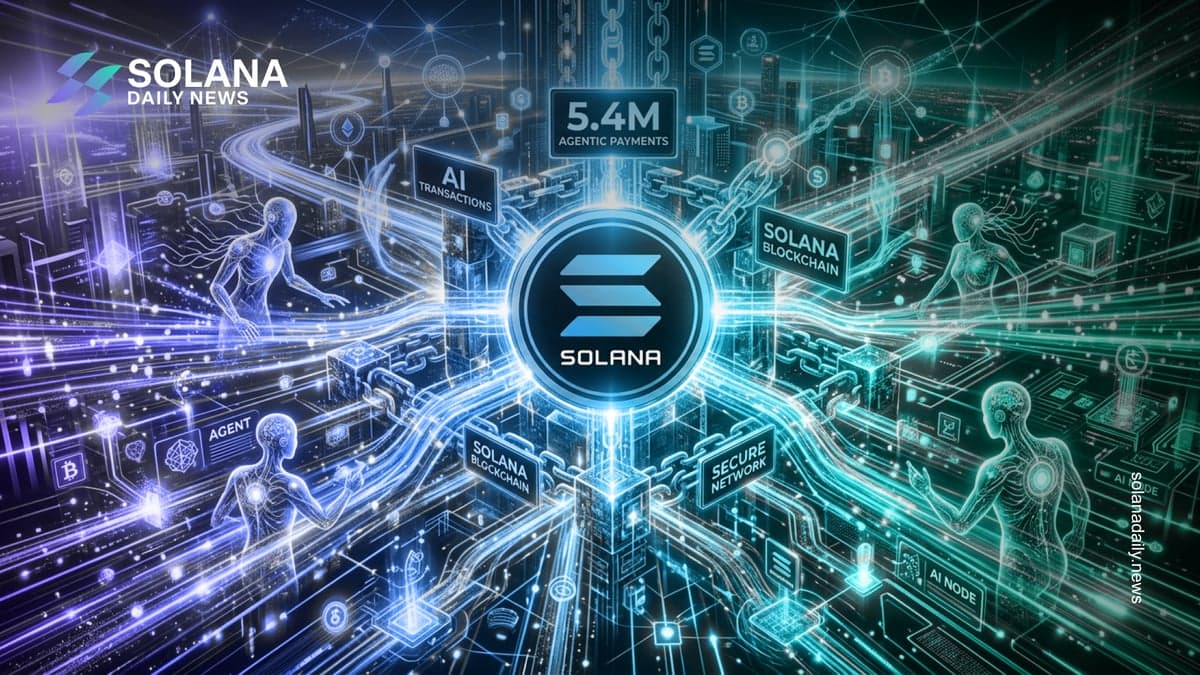
The figures highlight how blockchain networks can be used as payment rails for AI systems that need to automatically purchase data, compute, model access and other digital services.
For more information on Solana's agentic-payment infrastructure, readers can explore the official Solana x402 documentation.
What Are Agentic Payments?
Agentic payments refer to transactions initiated or managed by software agents rather than directly by humans.
An AI agent could, for example, need access to an API, purchase additional computing resources or request information from an external service. Instead of requiring a person to approve every transaction, the agent can use programmed payment infrastructure to complete the transaction automatically.
The x402 protocol is designed around this concept.
It uses the HTTP 402 Payment Required status to allow websites and APIs to request payment before providing a resource. Solana's documentation describes x402 as an open payment protocol designed to enable internet-native payments for AI agents and other applications.
PayAI Provides the Settlement Infrastructure
PayAI acts as an x402 facilitator, handling the verification and settlement layer between the payment request and the blockchain transaction.
In a typical x402 transaction, an AI client requests a resource and receives payment requirements. The client signs the payment, and the facilitator verifies and settles the transaction before the service is delivered.
This removes much of the blockchain infrastructure burden from the application or API provider.
PayAI's documentation explains that its facilitator provides APIs for verification and onchain settlement, allowing developers to integrate payment functionality without building the entire settlement infrastructure themselves.
Developers can also explore the official PayAI facilitator documentation.
BlockRun Uses Solana for AI Service Payments
BlockRun is using x402 to allow users and AI agents to pay for its AI services on a per-request basis.
The company announced its Solana integration with PayAI earlier this year, enabling its x402 endpoints to accept USDC on Solana.
According to BlockRun, the integration provides Solana wallet support and allows AI agents to pay for LLM and tool calls without requiring a separate payment workflow.
BlockRun's payment documentation shows how an unpaid API request can return a 402 Payment Required response, after which the client signs a payment and retries the request with the payment information.
That structure is particularly relevant to AI agents because payments can happen as part of the software workflow rather than through a traditional checkout page.
5.4 Million Payments Show the Potential Scale
The reported 5.4 million settlements in seven days represent a significant number of individual machine-driven transactions.
The average payment value is relatively small compared with traditional financial transactions, but that is part of the point of agentic payment infrastructure.
AI agents may need to make thousands or millions of small purchases over time.
A single agent could potentially pay for:
This creates a fundamentally different payments model from traditional subscriptions, where users pay a fixed amount regardless of how much of a service they consume.
Why Solana Matters for AI Payments
Speed and transaction costs become especially important when an AI agent is making frequent payments.
Solana's official x402 documentation highlights the network's fast finality and low transaction costs as reasons it can serve as an efficient settlement layer for agentic payments.
The network's payment infrastructure is also expanding beyond simple transfers.
Solana's official documentation now includes dedicated resources for agentic payments, x402 integrations and developer tools, reflecting the growing focus on machine-to-machine commerce.
This makes Solana increasingly relevant to applications where payment speed needs to keep pace with automated software activity.
AI Agents Could Become Blockchain's Next Major Payment Users
Traditional blockchain adoption has largely focused on humans interacting with wallets, exchanges and decentralized applications.
Agentic payments introduce a different model.
An AI agent can potentially operate continuously, discover services, compare prices and pay for resources without requiring a human to manually execute every transaction.
That creates the possibility of an economy where software becomes both the buyer and the user of digital services.
In that environment, payment infrastructure needs to be programmable, low-cost and capable of handling high transaction volumes.
BlockRun Targets 1 Billion Agentic Transactions
BlockRun's reported 5.4 million weekly settlements are still far below the company's longer-term ambition.
The company says it is targeting 1 billion agentic transactions in a single day, with the next milestone being 10 million transactions.
Reaching those numbers would require substantial growth in both AI-agent adoption and the number of services capable of accepting machine-to-machine payments.
The current activity nevertheless provides an early indication of what that market could eventually look like.
The x402 Economy Is Expanding
BlockRun is not the only project building around x402.
Solana's ecosystem now includes payment facilitators, developer tools and applications designed around autonomous payments. Solana's documentation specifically lists PayAI among the tooling available for x402 integrations.
The broader x402 model also allows developers to monetize APIs on a pay-per-request basis, potentially reducing the need for traditional accounts, subscriptions and API-key-based billing.
That could be particularly useful for AI agents, which may consume hundreds of different services from multiple providers during a single workflow.
What This Means for Solana
The growth of agentic payments gives Solana another potential use case beyond trading, DeFi and tokenized assets.
If AI agents increasingly need to purchase digital services autonomously, blockchains could become part of the underlying payment infrastructure connecting those agents to the internet.
The reported BlockRun activity suggests that this market is already generating meaningful transaction volume, although it remains an emerging sector and the long-term scale is still uncertain.
For developers, the important development is that the infrastructure is becoming easier to integrate.
The Solana agentic payments documentation provides tools and examples for developers building payment-enabled AI applications.
What to Watch Next
The next important indicators will be whether BlockRun can reach its 10 million transaction milestone, whether other AI applications begin generating comparable volumes and whether x402 becomes a widely adopted standard for machine-to-machine payments.
Developers will also be watching settlement costs, transaction speeds, stablecoin adoption and the security of autonomous payment systems.
If AI agents begin making millions of payments every week, the infrastructure supporting those transactions could become an important part of the emerging AI-plus-blockchain economy.
The 5.4 million payments reported by BlockRun and PayAI offer an early glimpse of that future: AI agents are beginning to use blockchain not simply to hold assets, but to autonomously pay for the digital resources they need.