Solana Tests the Effects of Faster Slot Production
Solana has begun operating with a 250ms slot target, down from the previous 400ms configuration, as the network progresses toward its longer-term goal of shorter slots. The change is part of an effort to use Solana’s improving infrastructure to reduce latency while measuring how the network behaves under tighter timing conditions. The official Solana analysis of slot time reduction examines the effects directly through onchain data.
The analysis begins with block 440,208,000, or Epoch 1,019, marking a major point in Solana’s move toward shorter slot durations. Rather than treating faster slots as a performance metric on its own, the research examines whether validators can maintain reliable block production and what changes appear in voting, validator economics and transaction ordering.
The findings so far show a mixed but measurable impact. Skip rates have remained stable and low, consecutive periods without a new canonical block have become shorter, and the maximum continuous leadership window has declined. At the same time, vote latency has increased, particularly for validators in Asia and South America.
Skip Rates Remain Stable as Slots Get Shorter
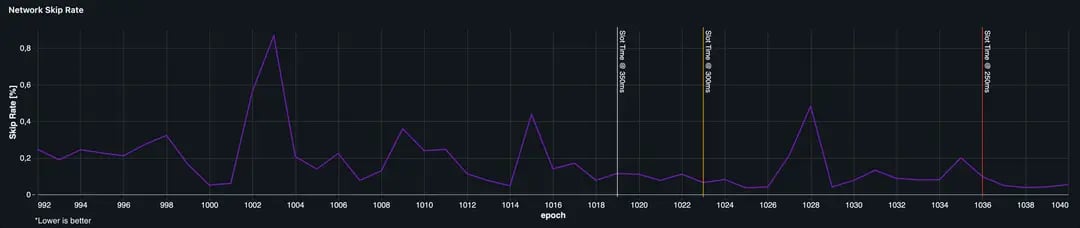
One of the most important measurements is Solana’s skip rate, which tracks scheduled slots that do not successfully become part of the final canonical history.
A slot can be skipped because its scheduled leader is offline or because the proposed block belongs to a fork that is later abandoned. The research notes that reducing slot time primarily affects the second situation because a shorter slot gives a leader less time to produce a block before subsequent leaders treat the slot as missed.
Despite that tighter timing, the data shows that the overall skip rate remained stable during the slot-time reduction. This indicates that validators have generally continued to keep pace with the network's faster production target. The official Solana report likewise describes the current 250ms results as showing no dramatic change in skip behavior.
There are, however, geographic differences. The research identifies Asia-to-Oceania and Europe-to-Oceania leader handoffs as areas requiring closer monitoring. The available sample for the 250ms target is small, with only 7 observations for Asia-to-Oceania and 35 for Europe-to-Oceania, meaning the study says it cannot determine whether the observed pattern represents a real effect or statistical noise.
Shorter Slots Reduce Consecutive Dead Time
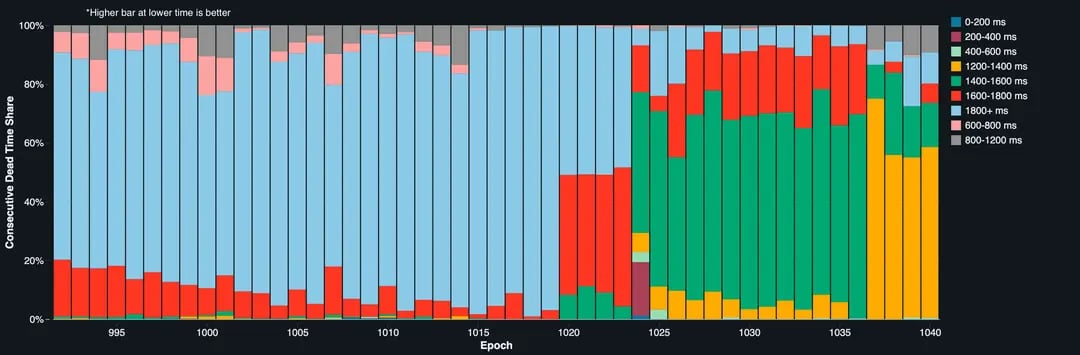
A stable skip rate has another effect when each slot is shorter: periods created by consecutive skipped slots occupy less time.
Solana defines consecutive dead time as the continuous period during which the network produces no new canonical block because multiple slots are skipped. That period ends when a later slot successfully lands on the canonical chain.
The analysis found that Solana moved from periods where more than 1,800 milliseconds of consecutive dead time was the dominant component to a range of approximately 1,200ms to 1,400ms. In practical terms, the network can experience skipped slots without those gaps consuming as much wall-clock time as they did under the longer slot configuration.
This distinction matters because a stable percentage of skipped slots does not necessarily translate into the same amount of network inactivity. When the duration of each slot decreases, the time lost during a sequence of skipped slots also decreases.
Vote Latency Is the Main Trade-Off
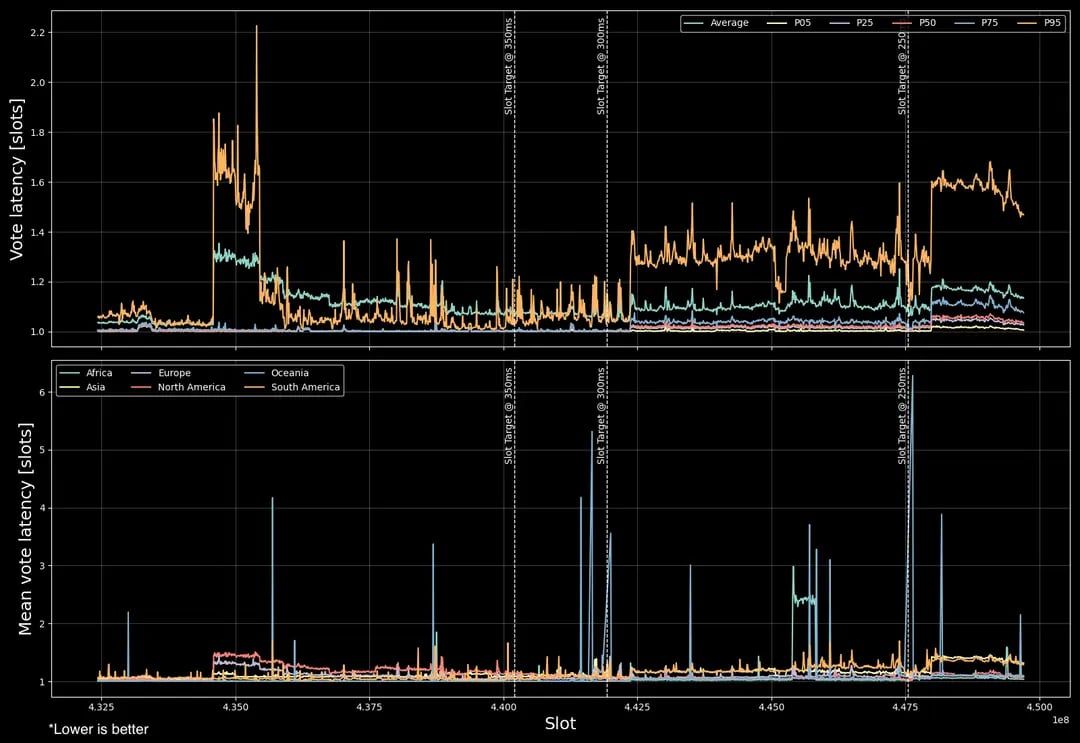
The research identifies higher vote latency as one of the clearest costs associated with shorter slots.
Solana votes are currently transactions that must land onchain. As the slot target becomes shorter, validators have less time to submit those transactions. The effect is particularly noticeable when the data is divided geographically, with Asia and South America showing the largest impact in the analysis.
Importantly, the observed increase in vote latency has not translated into evidence of consensus instability. The network-wide average remains below two slots, with voting behavior still generally occurring around slot N into slot N+1. The research therefore distinguishes between increased latency and an actual failure of consensus.
The issue is also expected to change with Alpenglow. Under the new consensus architecture, validator votes become direct messages rather than ordinary vote transactions included in blocks, with proof of voting collected within eight slots. Solana's current Alpenglow documentation describes the transition toward direct validator voting and roughly 150ms finality. Solana — Alpenglow
Validator Credit Loss Has Not Increased
Higher vote latency could potentially affect validator rewards because late votes can result in lost vote credits. The analysis therefore examines vote-credit deductions rather than relying only on average latency.
The results show that the overall probability of losing credits decreased during the observed slot-time reductions. The effect is also different depending on how validator stake is weighted.
Validators with larger amounts of stake lost proportionally fewer credits than the broader validator population when each validator is treated equally. The supplied research reports the following observed lost-credit fractions:
Slot target | Lost fraction, unweighted | Lost fraction, stake-weighted |
|---|
400ms | 2.1053% | 0.2622% |
350ms | 1.4361% | 0.1612% |
300ms | 2.0061% | 0.2327% |
250ms | 1.6360% | 0.0874% |
These figures show that vote latency should not be interpreted simply as an automatic increase in validator credit losses. The research notes that the fraction of credits lost does not move linearly and can depend on several network conditions.
Shorter Slots Shrink the Leader Control Window
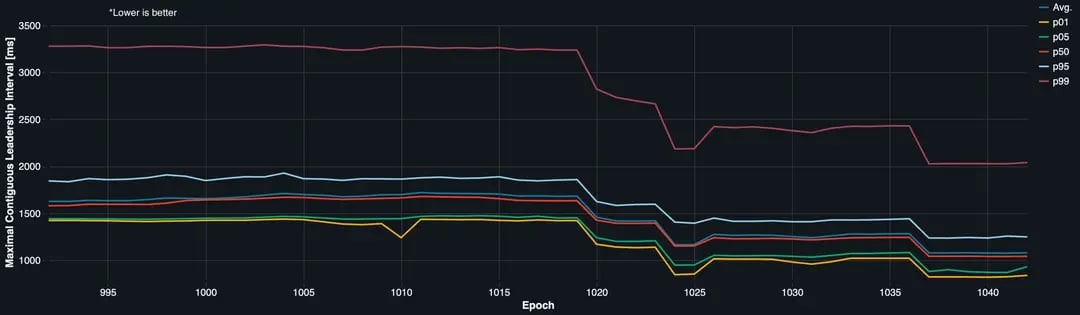
Another important effect appears in the amount of continuous time a validator can control transaction ordering while acting as leader.
Solana assigns leadership across consecutive slots. When the slot duration falls, the same number of consecutive leader slots represents less wall-clock time. This limits how long one validator can maintain a particular transaction-ordering regime.
The research's 99th percentile (p99) measurement of the maximum contiguous leadership interval fell from approximately 3 seconds to 2 seconds. The study describes this as a substantial reduction in the time available for a single leader to extract value from users.
Solana's separate analysis of slot-time economics also explains that reducing the target from 400ms to 200ms would cut the four-slot leader window from 1.6 seconds to 800ms. That research examines how the shorter window could affect market structure, validator economics and transaction execution. Solana — Lowering Slot Time and Validator Economics
What the Results Mean for Solana’s 200ms Goal
The current data does not establish that every consequence of shorter slots is uniformly positive or negative. Instead, it shows how different parts of Solana's infrastructure respond as the timing window becomes tighter.
The stable skip rate suggests that the slot-production pipeline has continued operating without a major deterioration in block production. At the same time, shorter slots reduce the duration of consecutive dead periods and limit how long a single leader can maintain control over transaction ordering.
The primary area requiring continued monitoring is vote latency, especially for validators affected by geographic network distances. The research specifically cautions against assuming that a 200ms target will have no additional consequences before Alpenglow changes how voting works.
Why the Slot-Time Reduction Matters
Solana's slot-time experiment is ultimately about more than producing blocks faster. It changes the timing structure of the network: leaders have less time to produce blocks, skipped-slot gaps become shorter, votes have less time to reach the chain, and individual validators have shorter continuous periods in which they control transaction ordering.
The available measurements suggest that Solana has so far been able to handle the reduction without a major increase in skip rates or evidence of consensus instability. At the same time, the geographic distribution of vote latency shows that network location remains an important factor when pushing the timing envelope.
The research concludes that the observed effects point toward a solid engineering framework, while the remaining debate around a 200ms target increasingly involves economic and philosophical questions rather than purely technical feasibility.
As Solana continues testing lower slot targets and prepares for Alpenglow, the key measurements will remain validator latency, skip behavior, vote economics, leader handoffs and the amount of continuous control available to individual block producers.