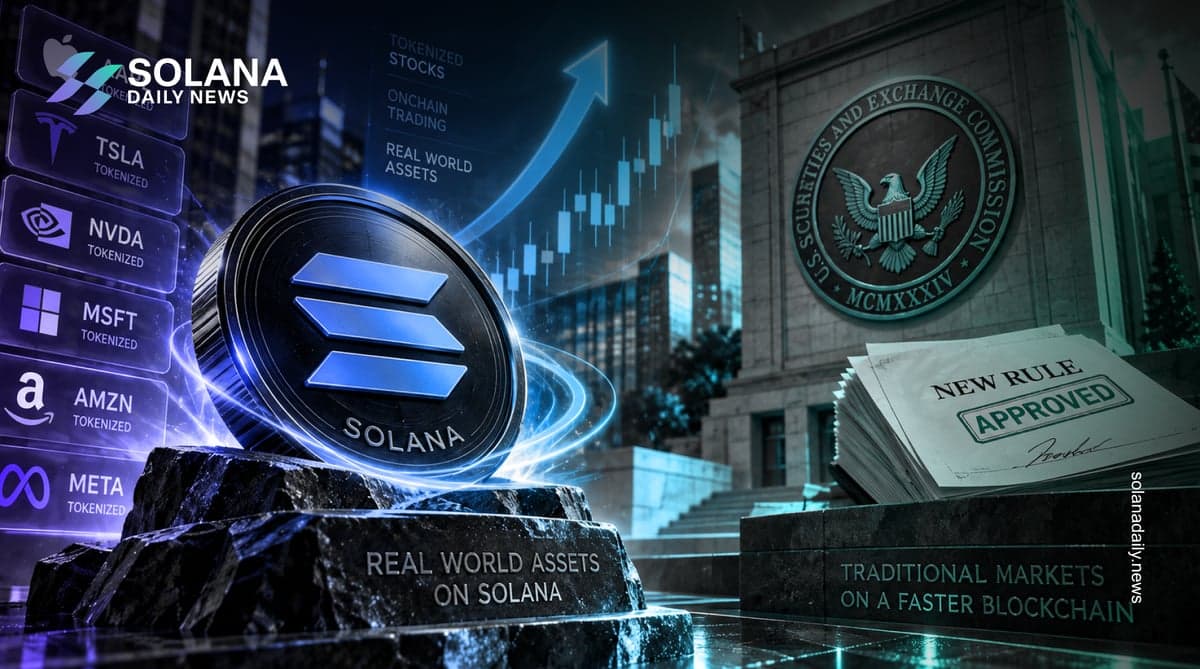
For Solana, the development is particularly relevant because the network already hosts a growing market for tokenized equities and other real-world assets.
How the SEC Innovation Exemption Works
The SEC’s framework allows qualifying TSVs to receive temporary relief from the definition of an “exchange” under the Securities Exchange Act.
Certain liquidity providers can also receive conditional relief from the definition of a “dealer” when they provide liquidity to eligible tokenized-stock pools using their own capital.
However, participating venues must meet a series of conditions.
These include:
Permissioned access to the tokenized-stock trading venue
Public and auditable smart contracts
Deployment on a public, permissionless blockchain
Limits on eligible stock symbols and trading volume
Tokenized stocks providing holders equivalent rights and privileges to the underlying securities
Coordination with trading halts on the underlying stock
Public disclosures covering venue operations and trading activity
Compliance with applicable securities laws, including anti-fraud and anti-manipulation provisions
The exemptions are scheduled to expire five years after publication, while the SEC is also requesting public comments on the framework and potential future regulatory changes.
Why the Rule Matters for Solana
Solana already has one of the more developed tokenized-asset ecosystems in the blockchain sector.
The Solana Foundation reported that the network’s real-world-asset value surpassed $4 billion in August, with more than 350,000 addresses holding RWAs. Its August ecosystem report also said xStocks had surpassed $500 million in assets under management, while Raydium had processed more than $4 billion in cumulative tokenized-stock volume.
Solana’s RWA infrastructure includes tokenized equities, ETFs, funds, commodities and other financial assets.
That existing activity gives the SEC’s new framework a direct connection to an ecosystem where tokenized stocks are already being issued, held and traded onchain.
Galaxy’s Tokenized GLXY Shares Are Already on Solana
One of the clearest examples is Galaxy Digital’s tokenized GLXY shares.
Galaxy partnered with Superstate to enable holders of its Class A common stock to tokenize their shares on the Solana blockchain.
Galaxy says these onchain shares represent actual SEC-registered Galaxy Digital Class A common stock and carry the same legal and economic rights as the traditionally formatted shares. Eligible holders can hold, send and receive the shares through self-custody.
However, there was an important limitation before the SEC’s new exemption.
Galaxy said it had not yet enabled AMM-based trading of tokenized GLXY, although bilateral transfers between allowlisted entities were possible.
The new SEC framework could therefore become relevant to the next stage of infrastructure for tokenized securities on Solana.
Secondary Trading Is the Key Development
The distinction between tokenization and secondary trading is important.
Tokenizing a stock creates an onchain representation of an underlying security. Secondary trading determines how holders can buy and sell that asset after issuance.
Galaxy Research said the SEC’s new exemption creates a potential path for secondary trading of tokenized stocks through qualifying TSVs using permissioned AMMs and liquidity pools.
That could matter for Solana because the network already provides infrastructure for onchain liquidity through decentralized exchanges, market makers and other financial applications.
The SEC framework, however, is specifically designed around permissioned trading venues. It should therefore not be interpreted as a blanket authorization for unrestricted decentralized trading of tokenized stocks.
Public Blockchain, Permissioned Market
One of the notable features of the SEC framework is the combination of a public blockchain with a permissioned trading venue.
The SEC says qualifying smart contracts must be deployed on a public, permissionless distributed ledger. At the same time, TSVs must establish standards governing who can access the trading pools.
This structure is compatible with blockchain networks such as Solana, where the underlying ledger is public while applications can implement compliance controls, allowlists and eligibility requirements.
For regulated securities, that distinction could allow financial institutions to use public blockchain infrastructure without making the trading venue itself fully permissionless.
Solana’s Tokenized-Equity Market Is Already Expanding
The SEC development arrives as Solana’s tokenized-equity market continues to grow.
According to the Solana Foundation’s August ecosystem report, tokenized-equity supply on Solana reached a weekly record of approximately $465 million. The same report said xStocks had more than 190,000 holders on Solana and more than $500 million in assets under management across over 700 tokenized stocks and ETFs.
Solana’s broader institutional RWA report also said that 97% of cumulative onchain tokenized-equity spot volume through late July had settled on Solana, highlighting the network’s existing position in this market.
These figures show that the SEC’s exemption is arriving alongside an already active tokenized-equity ecosystem rather than creating one from scratch.
Existing Tokenized Stocks May Still Need Adjustments
The SEC exemption does not automatically make every tokenized stock eligible for trading under the new framework.
Eligible securities must satisfy conditions concerning investor rights, transparency, issuer notification, trading limits and market-halt coordination.
The SEC also requires the underlying tokenized stock to provide holders with the same rights and privileges as the equivalent traditional security, including relevant shareholder rights. Issuers can also object to an unaffiliated tokenized version being made available on a TSV.
As a result, some existing tokenized-stock structures may need changes to their token design, compliance systems or trading infrastructure before they can use the exemption.
Five Years of Regulatory Testing
The Innovation Exemption is temporary.
The SEC has established the framework for five years, giving regulators and market participants time to observe how tokenized securities venues operate and collect data before potentially developing longer-term rules.
The SEC is also seeking public feedback on the framework.
That makes the next five years potentially important for the development of onchain securities infrastructure, as regulators can evaluate trading activity, liquidity, investor protections and how blockchain-based markets interact with traditional securities markets.
What It Could Mean for Solana
For Solana, the main opportunity is not simply the ability to tokenize more stocks.
The larger development is the possibility of expanding from onchain issuance and transfers toward regulated secondary-market infrastructure.
Solana already supports tokenized equities through platforms and issuers including Galaxy, Ondo and xStocks. The network also has established DeFi infrastructure that can provide liquidity and settlement capabilities for tokenized assets.
Whether the SEC framework results in significant additional activity will depend on which venues qualify, how issuers respond and how market participants use the new structure.
What Comes Next?
The immediate focus will be on how tokenized-stock issuers, trading venues and liquidity providers respond to the SEC’s conditions.
For Solana-based projects, key areas to watch include:
Permissioned trading infrastructure
Tokenized-stock shareholder rights
AMM and liquidity-pool design
Compliance and wallet eligibility
Secondary-market liquidity
Issuer participation
Trading-volume limits
Coordination with traditional exchange halts
The SEC’s five-year window also gives the industry time to test different models while regulators collect data and consider potential permanent rules.
Conclusion
The SEC’s Innovation Exemption creates a new regulatory pathway for certain tokenized U.S. stocks to trade through qualifying onchain venues.
The development is particularly relevant to Solana, where tokenized equities and other real-world assets have already become a significant part of the network’s ecosystem. Solana’s existing infrastructure includes tokenized stocks, institutional RWAs and onchain liquidity venues, giving the network an established foundation for this next stage.
The biggest change may be the potential transition from simply holding and transferring tokenized stocks onchain to building regulated secondary markets around them.
For Solana’s RWA ecosystem, the next milestone will be seeing which tokenized-stock platforms and trading venues can meet the SEC’s conditions and turn the temporary framework into real onchain market activity.