Open USD Goes Live on Solana
Open Standard has launched its Open USD (OUSD) stablecoin on Solana, giving businesses access to a dollar-denominated asset designed for payments, settlement and treasury operations.
According to Open Standard’s launch announcement, businesses can mint and burn OUSD on a 1:1 basis with U.S. dollars at no cost. The stablecoin is issued by Bridge, while its reserves are held with BlackRock, Lead Bank and BNY. Open Standard also says reserve attestations will be published monthly.
The launch puts OUSD directly onto Solana rather than introducing the stablecoin as a wrapped representation of an asset issued elsewhere. This distinction is central to Open Standard’s approach as it targets businesses and institutions that need stablecoin infrastructure for operational uses.
Coinbase, Mastercard and Other Companies Back OUSD
Open USD is launching with five founding partners: Coinbase, Mastercard, Shopify, Stripe and Visa. According to the supplied launch information, the five companies each took equal initial stakes and collectively committed more than $1 billion toward establishing OUSD liquidity.
The wider network supporting or planning to integrate OUSD has grown to more than 200 companies, with UBS, SBI Holdings and Jeeves among the organizations recently associated with the network.
Jamal Raees, General Manager of Payments at the Solana Foundation, said the usefulness of a stablecoin depends partly on the counterparties with which it can settle. He pointed to Solana’s existing stablecoin activity and institutional payment integrations as part of the rationale for OUSD launching on the network.
The launch therefore combines a new stablecoin with an existing ecosystem of financial and payments companies already building products around Solana.
What Native OUSD Issuance Means
One of OUSD’s key technical characteristics is that it is issued natively on Solana. There is no wrapped version representing OUSD that exists on another blockchain, meaning the Solana token itself is the issued instrument.
This structure can matter for businesses managing digital assets across financial operations. With a wrapped asset, users must also consider the infrastructure responsible for holding and transferring the underlying asset between networks. Native issuance removes that additional layer for OUSD users operating directly on Solana.
The OUSD mint address on Solana is:
ousd2mJsPEckLHcSCDxyKD7NDGARZcfLbDZkKiatYHB
OUSD uses Solana’s Token-2022 standard, which provides extensions that can add functionality at the token protocol level. Solana’s official Token Extensions documentation describes capabilities available through the standard, including features designed for regulated and institutional token use cases.
OUSD Targets Payments and Treasury Operations
Open Standard is positioning OUSD around practical business functions rather than only cryptocurrency trading. The stablecoin is intended for payments, settlement and treasury operations, allowing companies to use a dollar-denominated blockchain asset within existing financial workflows.
For businesses, stablecoins can provide a blockchain-based settlement mechanism without requiring users to handle the price volatility associated with assets such as Bitcoin or Solana’s native SOL token. OUSD’s 1:1 minting and redemption model is designed around that dollar-denominated use case.
The presence of major financial and payments companies among OUSD’s founding partners also gives the project a network of potential counterparties and distribution channels. However, actual adoption will depend on how individual companies integrate OUSD into their products and settlement systems.
Why OUSD Chose Solana
Open Standard says Solana’s existing payments and institutional ecosystem was an important factor behind the launch.
The network has attracted payment companies and financial institutions building blockchain-based products, including Western Union, Visa, PayPal and Fiserv, according to the launch material. This existing infrastructure gives OUSD a potential user base for settlement and payment applications from the beginning.
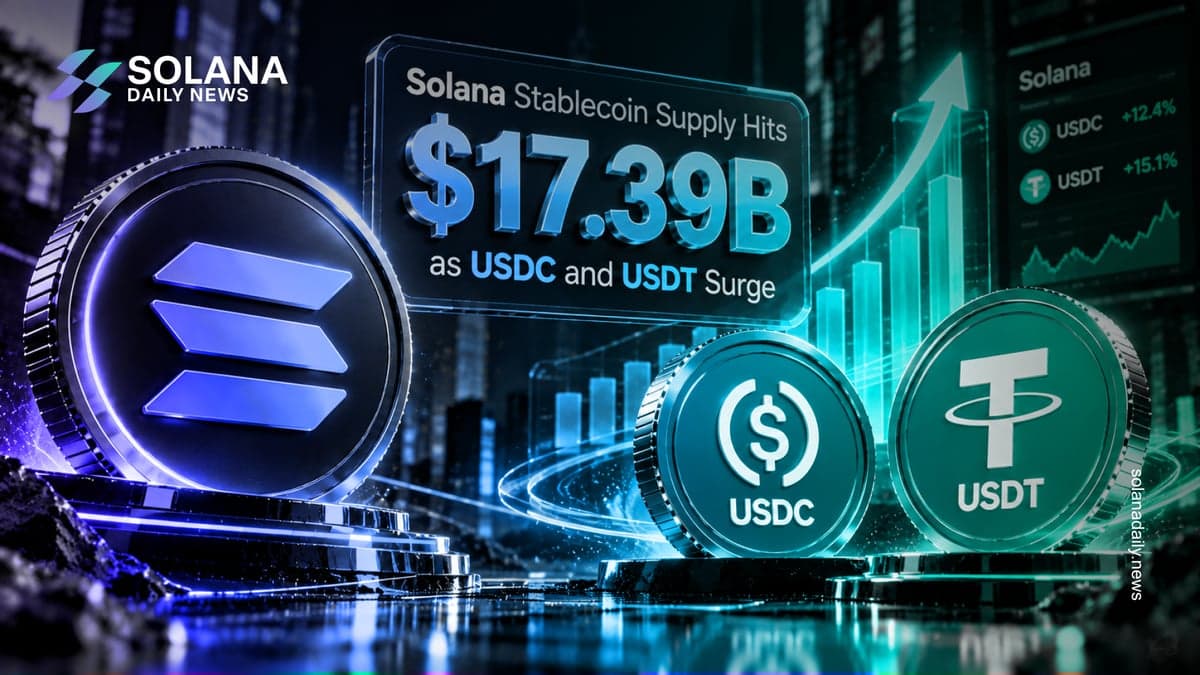
Solana’s stablecoin market has also expanded significantly. The supplied figures put total stablecoin volume processed by the network at more than $5 trillion in 2026, while stablecoin supply reached approximately $17.4 billion, representing an 18.8% year-over-year increase. The number of addresses moving stablecoins during a given week was also reported to have more than doubled over the same period.
Solana’s official stablecoin data dashboard provides a way to monitor activity across the network and gives context for the market in which OUSD is launching.
Low Transaction Costs Support High-Volume Payments
Transaction costs are another factor Open Standard highlights in its decision to issue OUSD on Solana.
The supplied launch material cites a median transaction fee of approximately $0.0013. For businesses processing large numbers of transactions, low per-transaction costs can affect whether blockchain settlement is economically practical for smaller payments and frequent transfers.
That can be particularly relevant for payment businesses, foreign-exchange operations and cross-border settlement, where transaction frequency can be high and costs can accumulate quickly.
Solana’s payments ecosystem is also being developed through Solana’s payments initiative, which focuses on infrastructure and applications for blockchain-based payments.
Token-2022 Adds Institutional-Focused Functionality
OUSD’s use of Token-2022 is another notable part of its Solana deployment.
Token-2022 is an extension of Solana’s token infrastructure that allows developers to use additional token-level features. These capabilities can be relevant for issuers building assets with specific compliance, transfer or privacy requirements.
The supplied material specifically references confidential transfers as an example of functionality that can be supported at the protocol level rather than being implemented through a separate smart contract. The exact features available to OUSD, however, depend on how Open Standard configures its token.
By combining native issuance with Token-2022, OUSD is targeting an infrastructure model where the stablecoin can operate directly within Solana’s existing ecosystem rather than relying on a separate wrapped-asset mechanism.
What to Watch After the Launch
The launch gives OUSD access to Solana’s existing stablecoin and payments infrastructure, but the next stage will depend on actual usage.
Key developments to monitor include the number of businesses integrating OUSD, growth in circulating supply, transaction activity, reserve attestations and the extent to which founding and ecosystem partners use the stablecoin for real settlement.
For Solana, OUSD adds another institutional-focused dollar asset to an expanding stablecoin market. For Open Standard, the launch provides the infrastructure needed to test its model for payments, settlement and treasury use cases directly on a high-throughput blockchain.
The combination of native Solana issuance, 1:1 dollar minting and redemption, Token-2022 functionality and a large group of initial corporate partners makes OUSD a notable new entrant in the network’s stablecoin ecosystem.