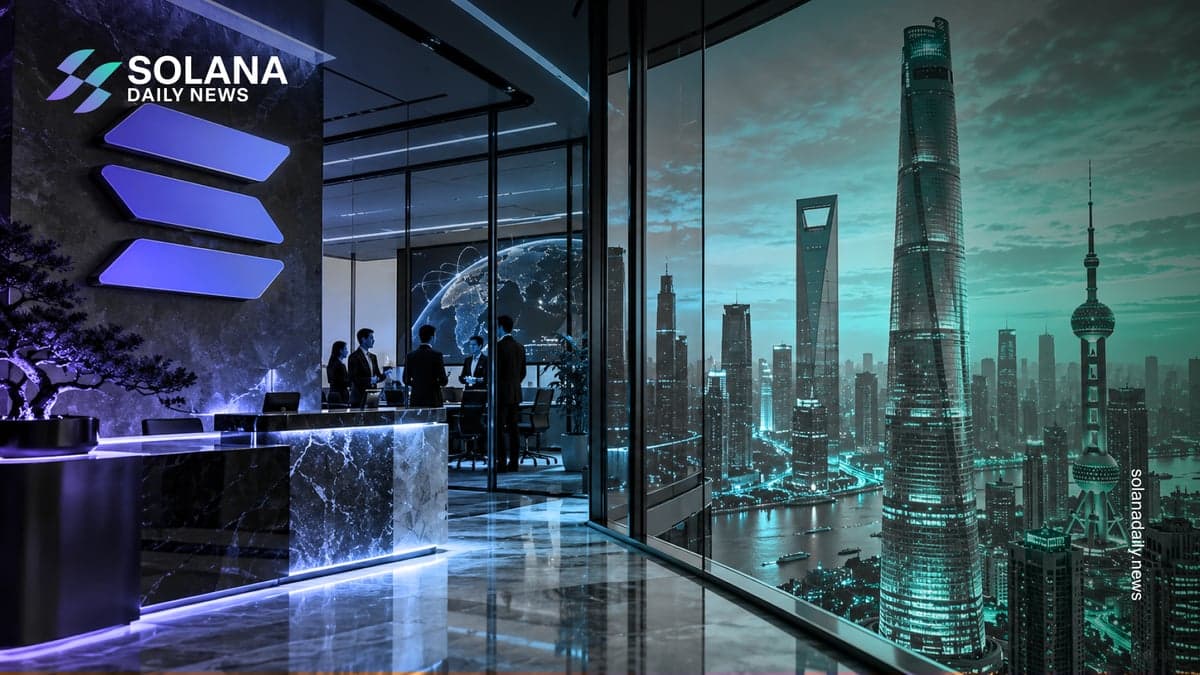
Solana (SOL) opened a new Solana Foundation office in Shanghai Tower, revealed in a video shared by Chief Product Officer Vibhu Norby. The presence inside the Lujiazui financial district drew immediate scrutiny across the industry because China has maintained firm anti-crypto policies even as one of the top-ten cryptocurrencies set up a commercial location.
The office sits within one of Shanghai’s highest commercial buildings, signaling a visible footprint in the city’s core financial hub. The development raised questions from senior digital-asset executives about how this was permitted under China’s historical restrictions, with the People’s Bank of China reiterating a hardened stance on digital assets in recent years.
What exactly did Solana establish in Shanghai?
Solana established a Solana Foundation office inside Shanghai Tower, located in the Lujiazui financial district. The space was first shown publicly in a video by Vibhu Norby, the foundation’s chief product officer. The footage indicated a formal, commercial presence rather than a temporary pop-up, positioning the organization within a premier corporate address.
While the video revealed the location and branding, operational details were not disclosed. There was no description of headcount, hiring plans, or the office’s functional mandate. Even without those specifics, occupancy in a landmark building underscores an intent to engage locally in some capacity, whether for outreach, ecosystem support, or partner meetings.
Why is a Shanghai office significant for Solana now?
The office is notable because China has maintained a stringent anti-crypto posture, and the People’s Bank of China has doubled down on that stance. Industry leaders questioned how a top-ten cryptocurrency was able to set up inside Shanghai Tower given that backdrop, highlighting a potential tension between policy signals and on-the-ground commercial activity.
For Solana’s ecosystem of developers, DeFi teams, and NFT founders, a visible footprint in Lujiazui could facilitate conversations with partners based in mainland financial hubs. However, the move also invites heightened scrutiny. Without clarity on scope, licensing, or permissible activities, the development is as much a compliance and optics story as it is a business expansion milestone.
What should Solana investors watch next?
Investors should watch for formal details from the Solana Foundation on the office’s purpose, governance, and any engagement parameters within China. Confirmation of permitted activities, staffing, or events would clarify whether this is primarily a representative office, a collaboration hub, or a broader operational base.
Market participants will also look for any response from local authorities or financial regulators that could validate—or challenge—the durability of this presence. Until then, the Shanghai Tower address is a conspicuous signal of intent, and the trajectory will depend on how policy realities intersect with Solana’s ecosystem goals.