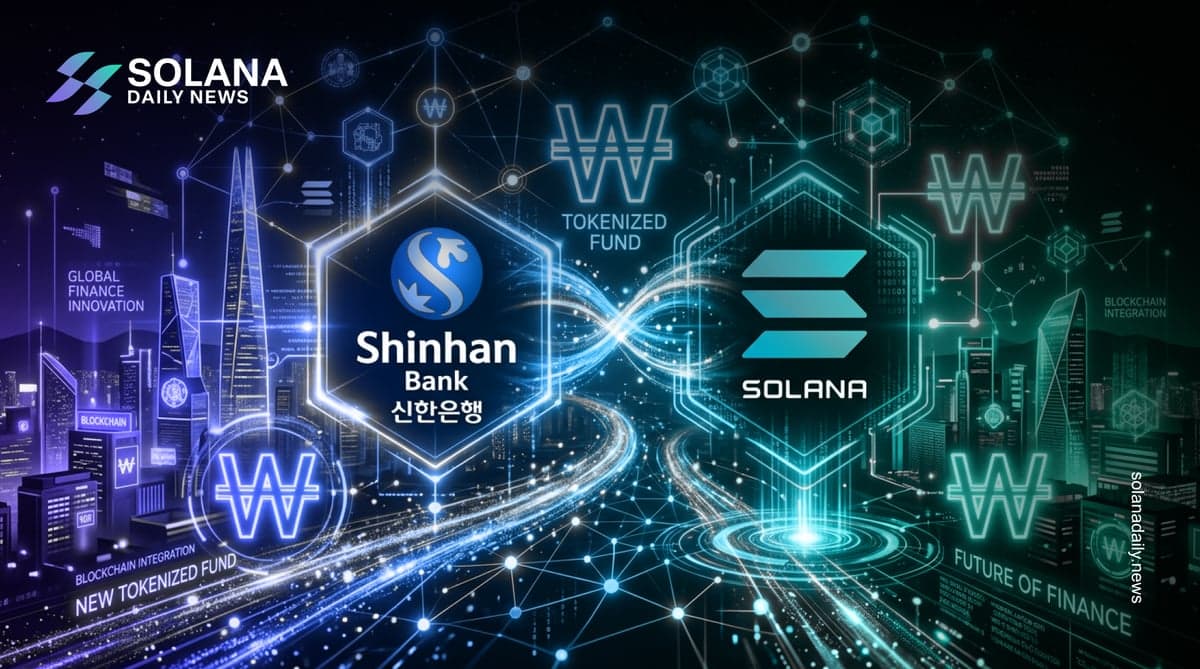
The initiative highlights Solana's growing role in institutional tokenization as asset managers experiment with blockchain infrastructure for traditional financial products.
Shinhan to Test Tokenized Fund on Solana
The proof of concept will examine the full process required to issue and distribute a regulated tokenized fund.
The participants plan to test several components, including:
Know-your-customer (KYC) procedures
Anti-money-laundering (AML) controls
Token issuance
Fund distribution
Onchain liquidity
Secondary-market transactions
Shinhan Asset Management will contribute its asset-management and regulatory expertise, while Etherfuse will provide infrastructure for creating and managing the tokenized assets.
Orca will focus on the liquidity infrastructure required to distribute and potentially exchange the fund tokens on Solana.
The Solana Foundation will support the broader blockchain component of the initiative.
The four-party structure is designed to test whether traditional investment products can move through an end-to-end blockchain-based infrastructure while maintaining the compliance requirements expected of regulated financial products.
Why Solana Is Being Used for Tokenization
Solana has increasingly positioned itself as infrastructure for institutional tokenization because of its high transaction capacity and relatively low transaction costs.
For a tokenized fund, those characteristics could be useful for activities such as subscriptions, redemptions, transfers and other transactions that require frequent settlement.
However, blockchain performance alone does not determine whether a tokenized financial product can succeed.
Issuers must also address securities regulations, custody, investor eligibility, KYC, AML requirements and market infrastructure.
The Shinhan project is therefore significant because it combines Solana's blockchain infrastructure with a regulated asset-management business rather than simply testing token transfers.
Shinhan's Fund Could Resemble the BUIDL Model
The Solana Foundation said the proposed structure draws inspiration from BlackRock's BUIDL fund, one of the most prominent tokenized money-market products.
The comparison is primarily about using blockchain infrastructure to distribute and manage traditional financial assets.
The underlying investments are different.
BlackRock's BUIDL primarily invests in U.S. Treasury bills, cash and repurchase agreements, while Shinhan's proposed product would focus on short-term Korean won-denominated bonds.
The distinction is important because the Shinhan initiative could provide a blockchain-based distribution model specifically for Korean financial assets.
Solana's Institutional Tokenization Push Expands in Asia
Shinhan's project adds to a growing number of institutional experiments involving Solana across Asia.
Japanese asset manager SBI Global Asset Management previously launched a tokenized Japanese equity fund on Solana, targeting institutional and accredited investors through regulated tokenization infrastructure.
This suggests Solana is increasingly being considered by Asian financial institutions as an infrastructure layer for bringing traditional assets onto public blockchains.
The trend also creates a potential opportunity for Solana to expand beyond its established role in decentralized finance and consumer applications.
Tokenized funds, equities, bonds and other real-world assets could become an increasingly important part of the network's institutional strategy.
Shinhan Is Also Testing Other Blockchains
The Solana partnership does not necessarily mean Shinhan has selected a single blockchain for its future tokenization infrastructure.
On Aug. 14, Shinhan Asset Management signed a separate agreement with Plume to develop a demonstration involving a won-denominated tokenized fund.
Running multiple proof-of-concept projects allows the asset manager to compare different blockchain architectures, liquidity systems and distribution models.
The eventual choice could depend on factors such as scalability, regulatory compatibility, institutional custody, liquidity and integration with South Korea's financial infrastructure.
South Korea's 2027 Tokenized Securities Rules Are Crucial
Regulation will ultimately play a major role in determining whether projects such as Shinhan's can move beyond experimentation.
South Korea's National Assembly passed amendments supporting tokenized securities on Jan. 15.
The legislation recognizes distributed ledger technology as a potential securities registry and allows qualifying investment contract securities to circulate through licensed securities companies.
The framework does not remove traditional securities requirements.
Issuers will still need to comply with applicable registration and disclosure rules, while unlicensed companies will not be permitted to broker tokenized securities.
The amendments are expected to take effect in early 2027, giving financial institutions time to prepare infrastructure and compliance systems.
South Korea Financial Services Commission
Regulatory Infrastructure Could Unlock Institutional Demand
The upcoming framework could be particularly important for tokenized funds.
Institutional investors typically require clear rules around ownership, custody, settlement, investor rights and regulatory protection before committing significant capital.
A regulated framework could therefore give asset managers greater certainty when designing blockchain-based investment products.
For Shinhan, completing the Solana proof of concept before the rules take effect could provide valuable experience with the operational and compliance requirements involved in tokenized securities.
Tokenized Real-World Assets Are Growing
The Shinhan initiative comes as the broader real-world asset (RWA) tokenization market continues to expand.
Tokenization allows traditional assets such as government debt, private credit, funds and equities to be represented as blockchain-based tokens.
The potential benefits include faster settlement, programmable ownership, improved transparency and access to global liquidity.
However, the technology remains relatively early, and market projections vary substantially.
The Solana Foundation cited estimates suggesting the tokenized real-world asset market could eventually reach trillions of dollars.
These figures are forecasts rather than guaranteed outcomes, but the growing number of institutional pilots suggests financial companies are increasingly treating tokenization as a serious area of infrastructure development.
What the Shinhan Deal Means for SOL
The initiative does not necessarily mean Shinhan will need to purchase large amounts of SOL.
The tokenized fund will primarily represent traditional Korean financial assets, while Solana provides the blockchain infrastructure used for issuance and distribution.
Nevertheless, greater institutional activity on Solana could strengthen the network's position in the tokenization market.
More institutional applications could increase network activity, attract developers and encourage financial institutions to build additional products on Solana.
The long-term impact on SOL will depend on how much of this experimentation eventually turns into production-scale activity.
Solana Moves Deeper Into Traditional Finance
Solana's institutional strategy is increasingly extending beyond crypto-native applications.
The Shinhan partnership places the network directly alongside:
A major Korean asset manager
A tokenization infrastructure provider
A decentralized exchange
A regulated financial-product use case
That combination could become increasingly important as traditional financial institutions explore public blockchains.
Rather than replacing existing financial systems overnight, tokenization could gradually connect traditional assets with blockchain-based settlement and liquidity networks.
What Happens Next?
The immediate focus will be on the completion of Shinhan's proof of concept.
The participants will need to determine whether the proposed infrastructure can support the fund's issuance, compliance requirements, distribution and liquidity processes.
The regulatory environment will then become increasingly important as South Korea moves toward implementing its tokenized securities framework in 2027.
A successful pilot could potentially lead to additional tokenized products and greater institutional use of Solana in South Korea.
However, there is still no confirmed commercial launch date for the proposed fund.
Final Thoughts
Shinhan Asset Management's partnership with the Solana Foundation, Etherfuse and Orca represents another important step in the development of institutional tokenization on Solana.
The proposed Korean won-denominated fund would focus on short-term domestic bonds and target overseas institutional investors, while the proof of concept will test everything from KYC and AML procedures to token issuance and onchain liquidity.
For Solana, the project reinforces its growing role as infrastructure for traditional financial assets.
The bigger opportunity could emerge as South Korea's tokenized securities framework takes effect in 2027.
If Shinhan and other financial institutions can successfully move regulated funds onto public blockchains, Solana could become an increasingly important bridge between traditional capital markets and the onchain economy.