Neither proposal automatically changes Solana's current monetary policy. Both must go through the network's governance and technical processes before any changes can be activated.
Solana considers doubling its disinflation rate
Solana currently follows a predetermined inflation schedule that reduces annual inflation over time until reaching a 1.5% terminal rate.
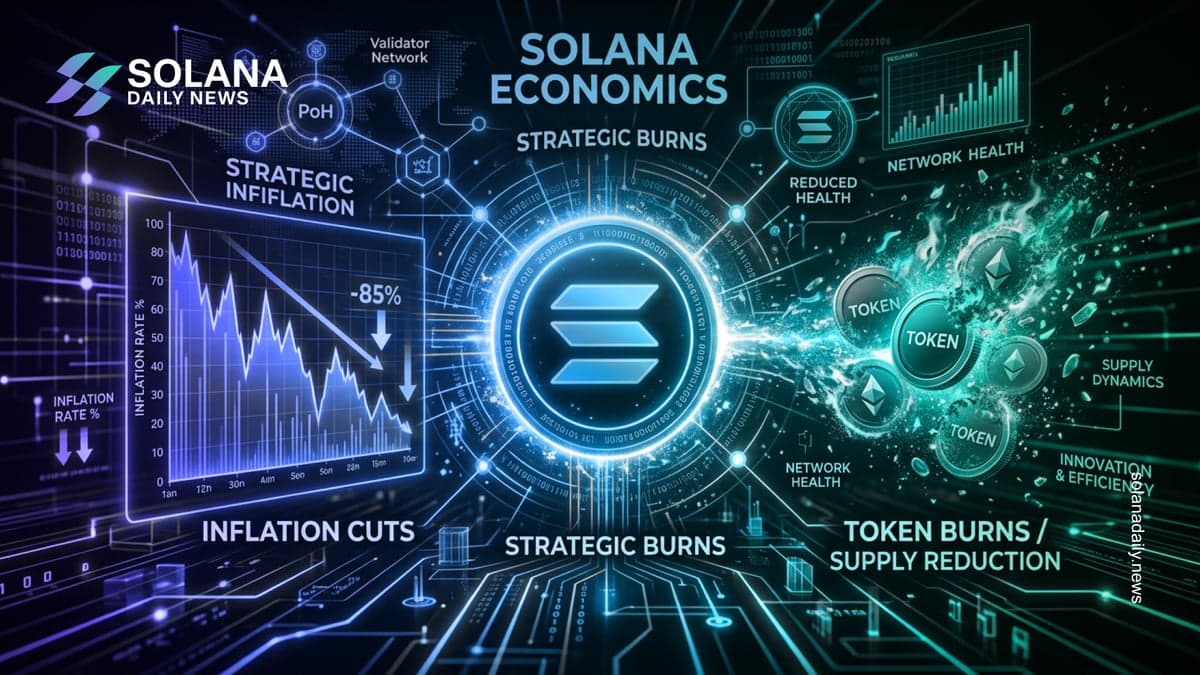
SGP-0002 proposes accelerating that process by increasing the annual disinflation rate from 15% to 30%.
According to the proposal, the change would shorten the estimated path to Solana's 1.5% terminal inflation rate from roughly 5.7 years to 2.8 years.
The proposal also estimates that approximately 18.9 million fewer SOL would be emitted over six years compared with the existing schedule.
Solana SGP-0002: Double Disinflation
Importantly, SGP-0002 would not redesign Solana's inflation system. Instead, it would accelerate the existing mechanism while keeping the terminal inflation rate at 1.5%.
That distinction matters because the proposal is primarily about how quickly SOL emissions decline, rather than introducing a completely new monetary model.
Governance support is required before activation
Solana's new governance framework separates broad community direction from the technical implementation of protocol changes.
An SGP is designed to answer whether the network should pursue a particular direction, while a Solana Improvement Document (SIMD) describes how the technical change would actually be implemented.
SGP-0002 is linked to SIMD-0550, which contains the technical proposal for doubling Solana's disinflation rate.
The SGP process requires at least 15% of stake to support holding a vote before the proposal enters the formal onchain governance process. A successful governance signal would still not automatically activate the technical change.
That means SOL's existing inflation schedule remains unchanged until the required governance, development and feature-gate processes are completed.
Solana also considers increasing SOL burns
The second major proposal, SGP-0003, focuses on transaction fees rather than staking emissions.
It supports SIMD-0553, which proposes introducing an inclusion fee and a resource-based fee linked to transaction resource consumption.
Under the proposal, the resource-based component would be burned entirely, potentially increasing the amount of SOL permanently removed from circulation.
SIMD-0553 on GitHub
Galaxy Research has highlighted the proposal as part of a broader discussion around Solana's transition toward an economic model increasingly supported by network activity rather than token emissions.
The potential impact on SOL supply, however, should not be treated as a fixed forecast. The amount burned would depend on transaction activity, resource usage and how developers and users respond to the fee structure.
Why Solana wants to reduce token emissions
The underlying debate is about how Solana should compensate validators as the network matures.
Token inflation provides rewards to validators and delegators, helping secure the network. However, newly issued SOL also increases the token supply.
As Solana's application ecosystem grows, supporters of lower inflation argue that more validator revenue should eventually come from actual network activity, including transaction fees, priority fees and MEV, rather than newly issued tokens.
Galaxy previously described this transition as an important part of Solana's economic development, noting that the network has evolved into a mature blockchain with significant application revenue and user activity.
The argument is therefore not simply that inflation is bad. Instead, the question is whether Solana still needs to rely on the same level of token issuance as the network's demand for blockspace increases.
Validator economics remain a key concern
Faster disinflation could benefit SOL holders by reducing future token issuance, but it also creates a trade-off for validators and delegators.
Lower inflation means fewer newly issued SOL tokens are available as staking rewards.
Validators could increasingly need to rely on other sources of revenue, including transaction fees, priority fees and MEV.
That could encourage greater efficiency across Solana's validator ecosystem, but it could also put pressure on operators with higher infrastructure costs or lower commission revenue.
Galaxy's previous analysis of Solana's inflation proposals highlighted this tension, noting that reducing emissions could complicate validator economics while lowering overall SOL supply growth.
Solana already has experience with inflation debates
This is not Solana's first attempt to change its inflation model.
An earlier proposal, SIMD-0228, attempted to introduce a more dynamic approach to SOL emissions. Validators ultimately rejected the proposal after it failed to reach the required approval threshold.
The failure demonstrated how sensitive changes to Solana's monetary policy can be, particularly when validator economics are directly affected.
The newer SGP framework provides a separate mechanism for collecting stake-weighted signals on major economic decisions.
SGP-0002 therefore represents a more straightforward approach: rather than replacing Solana's inflation mechanism, it proposes making the existing disinflation process happen faster.
Lower emissions and higher burns could reinforce SOL scarcity
If both proposals eventually become active, Solana could experience two changes working in the same direction.
First, less new SOL would be issued as the inflation schedule moves toward its terminal rate more quickly.
Second, more SOL could potentially be burned through the proposed transaction-fee changes.
Together, those mechanisms could reduce the pace of SOL supply growth.
However, the effect on SOL's market value would ultimately depend on demand for the network. Lower issuance alone does not guarantee higher prices.
For Solana, continued growth in DeFi, memecoins, payments, tokenized assets and other onchain applications could be more important over the long term because greater activity creates demand for blockspace and transaction fees.
Solana's governance process will determine what happens next
SGP-0002 and SGP-0003 still need to progress through Solana's governance process before the proposed changes can become network rules.
Under Solana's governance framework, an SGP provides a stake-weighted directional signal, while the technical implementation remains subject to the SIMD and development process.
That means investors should distinguish between a proposal, a governance vote and actual activation.
For now, Solana's existing inflation and fee mechanisms remain in place.
What the proposals mean for SOL
Solana's latest economic proposals point toward a broader shift in how the network could fund security and validator activity.
SGP-0002 would accelerate SOL's path toward the 1.5% terminal inflation rate, while SGP-0003 could increase the amount of SOL burned through transaction fees.
If adopted and implemented, the combination could make SOL's supply growth slower while placing greater emphasis on real network activity as a source of economic value.
For now, however, both changes remain proposals. The next major test will be whether Solana's validators and delegators support the faster disinflation and fee-burn strategy through the network's governance process.